
Amazon in 2026: the official figures change the conversation
We regularly hear that the major e-commerce opportunities are already behind us.
Yet when we look at the official figures, the story becomes far more interesting.
Because Amazon’s latest financial results tell a very different story.
In the second quarter of 2026, Amazon is still moving forward strongly. The marketplace continues to grow, units sold are increasing, and third-party sellers remain at the heart of the model.
For anyone interested in Amazon arbitrage, this is not a minor detail. It is a market signal.
Key takeaway:
- +17 % year-on-year growth in paid units sold worldwide;
- 61 % of paid units sold come from the third-party seller mix;
- 200.6 billion dollars in net revenue for the quarter;
- these data confirm one thing: Amazon remains a massive, active marketplace, and third-party sellers still occupy a central place within it.
These data come from Amazon’s official financial release, in the Supplemental Financial Information and Business Metrics table, supplemented by the Quartz article published after the results.
1. Units sold on Amazon are still growing strongly
The first key figure is simple: WW paid units, meaning paid units sold worldwide on Amazon, recorded year-on-year growth of 17 % in the second quarter of 2026.
This is no small change. On an already vast platform, double-digit growth means volume is continuing to increase.
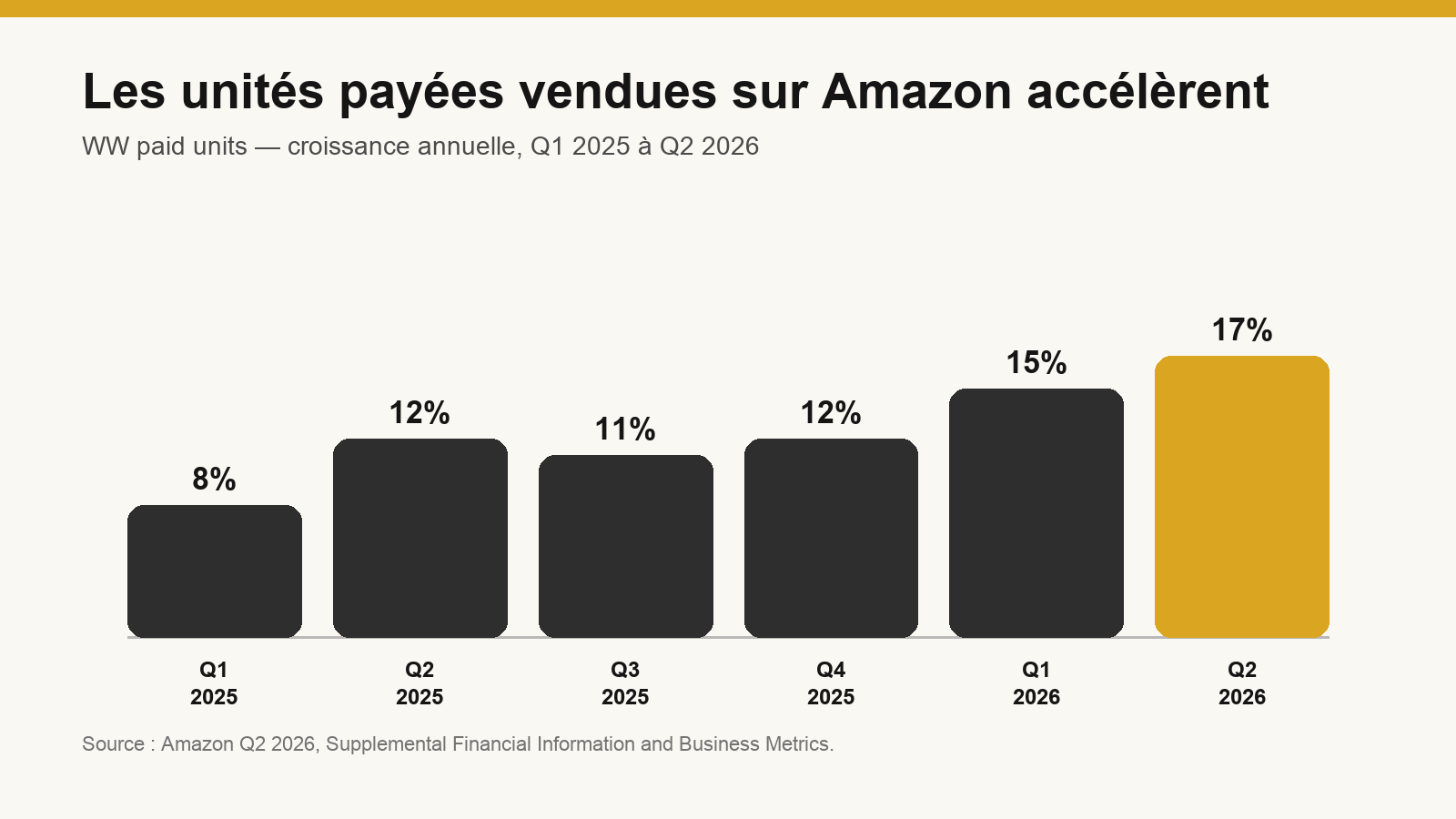
Source: Amazon Q2 2026, Supplemental Financial Information and Business Metrics — WW paid units, Y/Y growth.
For an independent seller, this figure does not mean everything is easy. It means something else: demand continues to exist at scale.
The real question therefore becomes: “How do you spot the right products in such a vast market?”
The real question is: do you know how to spot the right products before you buy?
2. Third-party sellers still account for the majority of units sold
The second figure is even more important for independent sellers.
Amazon states that the WW seller unit mix accounted for 61 % of paid units sold worldwide in the second quarter of 2026.
Put simply: more than 3 out of every 5 paid units sold on Amazon come from third-party sellers.
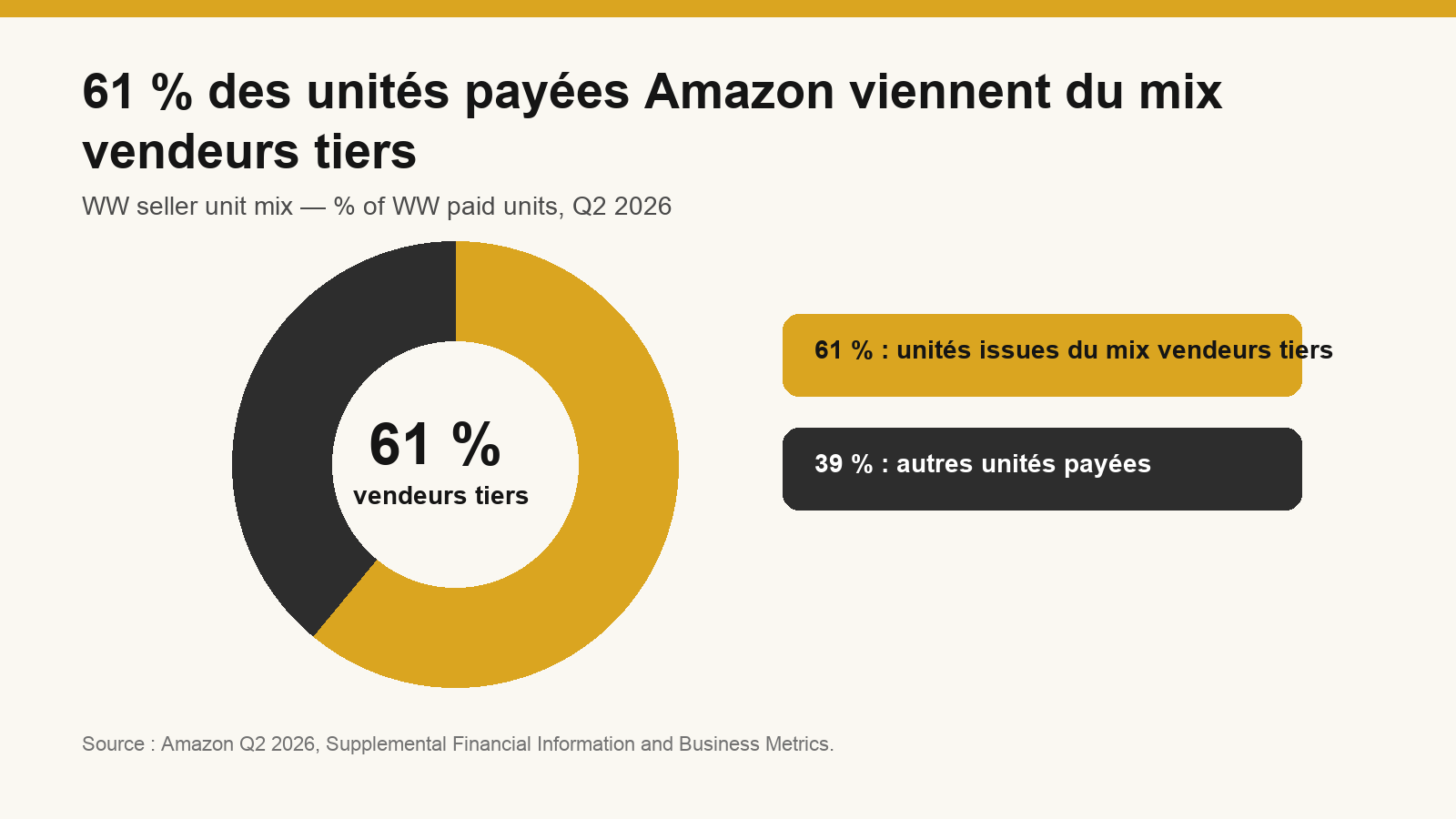
Source: Amazon Q2 2026, Supplemental Financial Information and Business Metrics — WW seller unit mix, % of WW paid units.
That is the point many people forget.
Amazon is not simply a retailer selling its own products. It is a global marketplace where independent sellers use Amazon’s visibility, trust, tools and, at times, logistics to sell their products.
Above all, this figure shows that third-party sellers are not on the fringes of the system. They are at its centre. And for anyone wanting to learn arbitrage, that is an extremely positive sign.
What these figures really tell us
Above all, these two figures tell us one thing: the opportunity is still very much alive.
Amazon remains a huge playing field, with millions of customers, colossal transaction volumes and an ever-central role for third-party sellers.
The platform continues to sell huge volumes, and third-party sellers still account for the majority of paid units sold.
What this shows is that the potential is still there.
The playing field is vast, active and alive.
And on such a vast playing field, the difference does not come down to luck.
It comes down to method.
And the larger a market is, the more valuable the ability to read the right signals becomes.
That is exactly what makes Amazon interesting for arbitrage.
On such a large marketplace, someone who can read the figures can see what others do not yet see.
And that is precisely where method becomes an advantage.
Why the opportunity is still underestimated

There is something quite fascinating about Amazon.
Everyone knows Amazon. Everyone orders from Amazon. Everyone knows Amazon has become an e-commerce giant.
Yet very few people still view Amazon as a genuine business opportunity.
Today, attention is elsewhere. It is on artificial intelligence. Before that, it was on NFTs. Before that, crypto. Before that, dropshipping.
Each time, it is the same scenario. A new topic becomes fashionable. Everyone talks about it. Everyone wants to get started. Everyone thinks they have found the next big thing.
Meanwhile, Amazon keeps selling. Not in theory. Not in a pitch. Every day.
It may not be the noisiest topic right now. But it is a real market, with real customers, real products, real orders and real data to analyse.
The real issue: knowing how to turn data into decisions
The wrong question is: “Are there still products left to sell on Amazon?”
The right question is: “Do I know how to analyse a product properly before buying it?”
Amazon arbitrage is not buying a product because it is on promotion. It is not filling a trolley because a price seems low. It is not copying a TikTok video.
It is far more tangible than that.
- You verify actual demand.
- You analyse the competition.
- You check the selling restrictions.
- You look at the price history.
- You monitor sales stability.
- You set your maximum purchase price.
- And only then do you buy.

It is tangible, measurable and, above all, far more accessible when you know what to look for.
The mistakes that cost beginners dearly
Beginners often waste time because they focus on the wrong signal.
They see a promotion, but not necessarily the demand.
They see a low price, but not always the fees.
They see a well-known product, but not the competition on the listing.
They see an opportunity, but not yet the risk.
That is exactly where the method changes everything.
It helps you sort faster, avoid poor purchases and focus your energy on products that genuinely deserve analysis.
Where arbitrage becomes powerful
Arbitrage becomes powerful when you stop viewing Amazon as a simple shopping site.
You start to view it as a huge commercial database.
Every product listing becomes a signal.
Every price change becomes a lead.
Every stockout, every promotion and every difference between two marketplaces can become an opportunity worth checking.
That is what makes the model interesting.
You do not need to invent a product.
You do not need to create a brand from day one.
You do not need to convince the market to buy online.
The market is already there.
Your job is to learn to spot the right differences before everyone else.
Amazon is accelerating, and methodical sellers have an opportunity to seize
The second-quarter 2026 results are excellent news for those who look at Amazon through an entrepreneur’s eyes.
They show a marketplace that continues to grow, increasing paid units, and third-party sellers that remain at the heart of the model.
In other words: the market is moving, customers are buying, and opportunities are still circulating.
And for an arbitrage seller, that is precisely what we want.
A huge playing field. Data. Price differences. Products to compare. Signals to read. Decisions to make.
In 2026, the advantage belongs to those who can spot opportunities faster, calculate more accurately, buy more intelligently and proceed methodically.
In conclusion
Amazon remains an opportunity because the market is active.
The official figures confirm it: units sold are increasing, third-party sellers remain the majority in the paid-unit mix, and Amazon exceeds 200 billion dollars in net revenue for the quarter.
This opportunity is particularly appealing to those who want to build something tangible.
Learn to analyse. Source. Calculate. Test. Improve. Understand the figures. And turn Amazon into a genuine field of opportunity.
The market is there. The products are there. The customers are there.
The real question is: do you know how to spot them?
Would you like to look at Amazon through a seller's eyes?
If you want to go further, talk with other Amazon sellers and understand how arbitrage works in practice day to day, you can join our open Telegram community.
We share a clear vision, practical advice, field feedback and opportunities to analyse methodically.
The aim is simple: to help you see Amazon differently—not only as a customer, but as someone learning to spot the right products, the right signals and the right differences.
Join the AMZSC Telegram community here: [https://t.me/amazonsellerconsulting]
Sources
- Amazon — Amazon.com Announces Second Quarter Results, Q2 2026, Supplemental Financial Information and Business Metrics table.
- Quartz — Amazon’s cloud business grew by 37 % as quarterly revenue exceeded 200 billion dollars, 30 July 2026.