
Are you reselling on Amazon a product from a brand already known in France, and is Amazon mentioning EPR or an IDU? The right question is not: ‘Should I open a number as a precaution?’ The right question is: who first placed this product on the French market?
Short answer
Reselling a product already placed on the French market does not automatically make you the producer responsible under EPR. However, if you import the product, market it under your own brand or are the first to offer it in France, your situation may change. Before reaching any conclusion, you need to identify the product’s actual supply route.
This page helps you understand the terms Amazon uses, distinguish the most common situations and find useful information about a brand. The aim is simple: avoid panic, unnecessary steps and oversights that could later block your business.
EPR: what exactly are we talking about?
EPR means extended producer responsibility. It is a principle that organises responsibility for the end-of-life management of certain products: collection, sorting, recycling and treatment. In France, the businesses concerned may in particular need to join an approved producer responsibility organisation, declare the quantities placed on the market and obtain a unique identifier, called an IDU.
The issue does not concern only major brands. Depending on the product and how it is introduced in France, very common Amazon categories may be concerned: packaging, electrical and electronic equipment, cells and batteries, furniture, textiles, toys, sports or DIY items.
Who is a producer for EPR purposes?
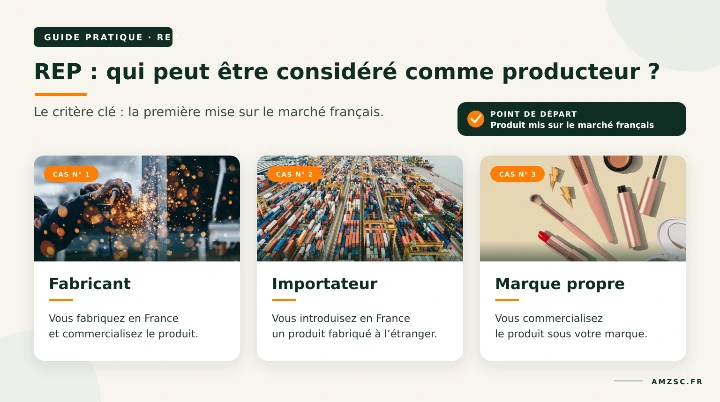
In everyday language, a producer suggests a factory or the owner of a major brand. In EPR, the reasoning is different: the key point is the first placing on the French market.
- A manufacturer may be concerned when they manufacture and market a product in France.
- An importer may be concerned when they introduce into France a product manufactured abroad.
- A distributor may be concerned when they market a product under their own brand.
This is why the same person may simply be a reseller for one product and fall under EPR for another. It is not the word ‘seller’ that provides the answer: it is the concrete route followed by the product to the French market.
Amazon and EPR: situations to distinguish
You buy in France and resell the product as is
You buy from an identified French supplier, then resell a product already present on the French market, without altering it or marketing it under your own brand. This is the situation that often leads you first to check the identity of the brand or the first party placing it on the market, rather than immediately creating an IDU in your own name.
You import a product into France
The product comes from abroad and you are the person introducing it to the French market. The importer’s role may then become decisive. You need to consider the scheme or schemes that may apply to the product, as well as the position regarding packaging.
You sell under your own brand
Own brand, personalised product, packaging in your name or a bundle presented as your offer: these are situations that merit specific analysis. The fact that a third-party manufacturer made the product is not enough to rule out your role in placing it on the market.
The product is electronic or runs on batteries
The same product may fall under several sets of rules. An electronic device may require consideration of electrical and electronic equipment; if it contains a battery or cells, that component must also be considered. Packaging is another aspect to keep in mind.
IDU: what is this number for?
The unique identifier (IDU) identifies a producer registered for an EPR scheme. A producer may have several IDUs because a single product or activity may fall under several schemes. An IDU is therefore neither a universal label nor a mere formality to copy: it must correspond to a specific company and scheme.
Amazon may request compliance information for certain categories. The important thing is not to reply at random: start by identifying the category, each party’s role and the person or company that bears the obligation for the product concerned.
How do you check a brand’s IDU?
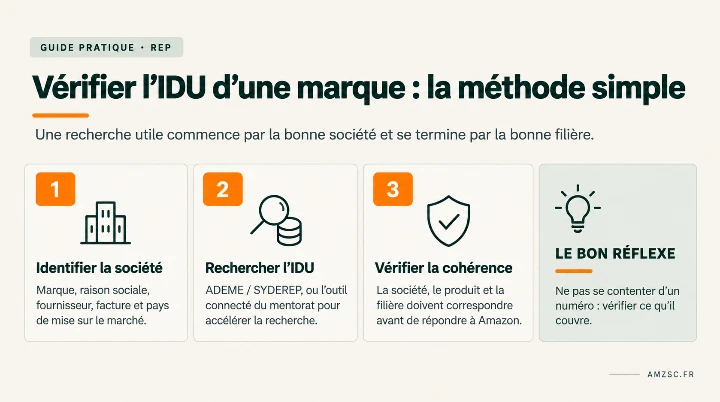
- Identify the brand and the company. Look for the legal entity actually connected to the product, not only the marketing name shown on the Amazon listing.
- Identify the possible categories. Electronics, cells, packaging, textiles or other: one product reference may require several checks.
- Use the ADEME/SYDEREP search. The public search engine lets you look for a registered producer, in particular by legal entity name or IDU.
- Keep the useful evidence. A screenshot of the search, supplier information and related documents may help you reconstruct your reasoning if a check is needed later.
- Do not draw conclusions too quickly. Finding an IDU is important information, but you still need to make sure it matches the company and the scheme for the product being assessed.
ADEME’s public database is updated regularly and also allows bulk searches through its open dataset.
In the mentoring programme: in addition to the ADEME/SYDEREP search, members have access to a tool connected to the ADEME database to find the company and the IDU to check more quickly. It speeds up the search; checking the product, the scheme and your role remains essential.
The mistakes that waste time
- Creating an IDU ‘just in case’ before establishing your actual role.
- Confusing a brand with the company responsible for placing the product on the market.
- Forgetting the product’s components, especially packaging, cells or batteries.
- Thinking that a product falls under only one scheme.
- Replying to Amazon without a method because a message seems urgent.
Amazon EPR: which categories should you look at first?
There is not one single ‘Amazon EPR number’ that covers all products. Obligations are assessed by scheme and according to the product’s characteristics. Here are the useful questions to ask during an assessment:
| Situation or product | A habit to adopt |
|---|---|
| Product sold in packaging intended for an individual consumer | Do not forget packaging, even if the main product already appears to be covered. |
| Device, electrical accessory or connected object | Check the electrical and electronic equipment category, often called EEE or WEEE. |
| Cells or integrated battery | Also identify the cells and batteries component: it cannot be inferred automatically from the category of the main product alone. |
| New textiles, footwear or household linen | Check the relevant scheme and the actual status of the company placing the product on the market. |
| Toy, furniture, sports, DIY or garden item | Do not assume that a product is ‘outside EPR’ because it is not electronic. |
The right habit is not to memorise all the regulations. It is to get used to looking at the product as a whole: the product, its components, its packaging and the route that brought it to the French customer.
France, Germany: do not mix up the procedures
Environmental obligations are managed country by country. A French identifier does not automatically answer a German request, and vice versa. In Germany, Amazon may in particular request a LUCID number for packaging; that number belongs to a separate register. If you sell on several European marketplaces, always start by identifying the country of sale and the category concerned before looking for a solution.
This point is particularly important for Amazon sellers: compliance is not simply a matter of copying a number into Seller Central. You need to know which number corresponds to which company, country and scheme.
Amazon is asking you for an EPR number: what should you do in practice?
- Read the request again. Identify the country, the category mentioned and the ASINs or products concerned.
- Do not reply with a number chosen at random. A number that does not match the right scheme or the right company does not solve the problem.
- Trace the supply chain. Invoice, supplier, brand, possible import: gather the elements that explain how the product reached the French market.
- Check the public and contractual information. The ADEME/SYDEREP search is a starting point; supplier documents complete the picture.
- Decide based on your actual role. The answer may differ depending on whether you resell locally, import or market products under your own brand.
This approach is more useful than a panic reaction. It helps you deal with an Amazon request using consistent information and understand the products you decide to add to your catalogue.
The method to remember before buying or selling
Before committing money to a product, add this check to your usual analysis:
- What exactly is the product and which components does it contain?
- Who first placed it on the French market?
- Is it local resale, an import or an own-brand offer?
- What official or supplier information can confirm this assessment?
- What consistent response should you give if Amazon requests compliance information?
This method does not replace work on profitability, Amazon restrictions, invoices or demand. It simply avoids discovering a compliance issue after you have already tied up stock.
Frequently asked questions about EPR and Amazon
Open a question to display the answer.
Do you need an IDU to sell on Amazon France?
Not automatically. The answer depends on the product, the scheme concerned and, above all, your role in its first placing on the French market.
Is an Amazon reseller always an EPR producer?
No. Reselling a product already placed on the French market is not, by itself, enough to answer yes. Importing, own branding and the supply chain change the assessment.
How can you tell whether a brand has an IDU?
The public ADEME/SYDEREP search lets you look for a registered producer, in particular by legal entity name or IDU. Then check that the information matches the product and scheme concerned.
What does IDU mean on Amazon?
It is the unique identifier associated with a producer’s registration in an EPR scheme. Amazon may request it depending on the product category and the applicable obligations.
Can an electronic product fall under several obligations?
Yes. A product may have several elements to consider, for example the equipment itself, a battery or cells, and its packaging.
Should you be concerned if Amazon asks for EPR information?
The request must be handled seriously, without panicking. Start by clarifying your situation and gathering consistent information before making a decision.
Do you want to manage your EPR obligations without making mistakes?
In AMZ Seller Consulting’s mentoring programme, we help you understand the steps surrounding your business, find useful information about a brand and move forward with a clear method when compliance matters become unclear.
Book a call to find out about the support available