Skip to Content
  •    
AMZ Seller Consulting
  • Sign in
  • English (UK) Français Deutsch Italiano Español
  • ​​​Contact us
  • Home
  • Success Stories
  • Articles
  • Courses
  • Our support
  • Telegram
  • About us
  • Help
AMZ Seller Consulting
      • Home
      • Success Stories
      • Articles
      • Courses
      • Our support
      • Telegram
      • About us
      • Help
    •    
    • English (UK) Français Deutsch Italiano Español
    • Sign in
    • ​​​Contact us

    Amazon arbitrage: Succeeding with retail/online arbitrage


    Table of contents


    Are you looking for a business you can build seriously, as a side activity or your main project?

    Amazon arbitrage can become a genuine resale business: the more solid your method, the more able you are to spot, validate, and repeat good opportunities.

    What is Amazon arbitrage? 

    It means spotting pricing opportunities around you—whether in-store or online—then validating them before reselling on Amazon.

    2 methods:

    • RETAIL ARBITRAGE: you go to a store, spot a genuine deal, and check whether it can become a worthwhile sale on Amazon. The idea is not to buy because something is discounted; it is to buy only when the product, price, fees, and demand all tell the same story.
    • ONLINE ARBITRAGE: as the name suggests, this is the same operation, but on the web. "Online" comfortably from anywhere in the world, whenever you choose.


    This method, detailed here, compares dropshipping and private label to help you choose the model that suits your goals. Discover the steps to get started, tools such as SellerAMP, Keepa, and Sellerboard to optimize your earnings, and mistakes to avoid. Turn undervalued products into income through concrete examples and a proven strategy to maximize your ROI from your first sales.

    1. Amazon arbitrage today: still a real opportunity?
    2. Amazon arbitrage, private label, dropshipping: comparing Amazon sales models
    3. A step-by-step guide to getting started with Amazon arbitrage
    4. The essential tools for maximizing your profits
    5. Concrete examples and earnings estimates: how much can you really make?
    6. 5 beginner mistakes that can sink your business (and how to avoid them)
    7. Training to scale: the key to moving from side income to a real business
    8. Ready to get started? Your action plan for starting Amazon arbitrage today


    Amazon arbitrage today: still a real opportunity?


    The answer is YES!

    Why?

    Because Amazon is the LARGEST marketplace used by consumers around the world.

    Amazon has more than 840 million listings to analyze in France alone today. From a pack of tissues to a board game or LEGO set, opportunities are everywhere: the difference lies in how you find and validate them.

    So you do not need an enormous financial investment; you can generate profit from all types of products.

    How do you know?

    We have a reliable method, using verified and regularly updated data,  to ensure your products are profitable. 


    Retail arbitrage vs. online arbitrage: which method should you choose?


    Retail arbitrage (RA): the in-store treasure hunt


    top view of mall interior


    Retail Arbitrage involves buying products in physical stores after analyzing them with SellerAMP to resell them on Amazon at a profit. 

    This method is accessible because it does not require a huge investment.  It relies on clearance or promotional offers at major retailers such as Leclerc, Action, Noz, and others, where end-of-season discounts reach 75% to 90%.

    It can uncover less competitive products—provided you check the history, number of sellers, fees, and restrictions before buying.

    Example: 

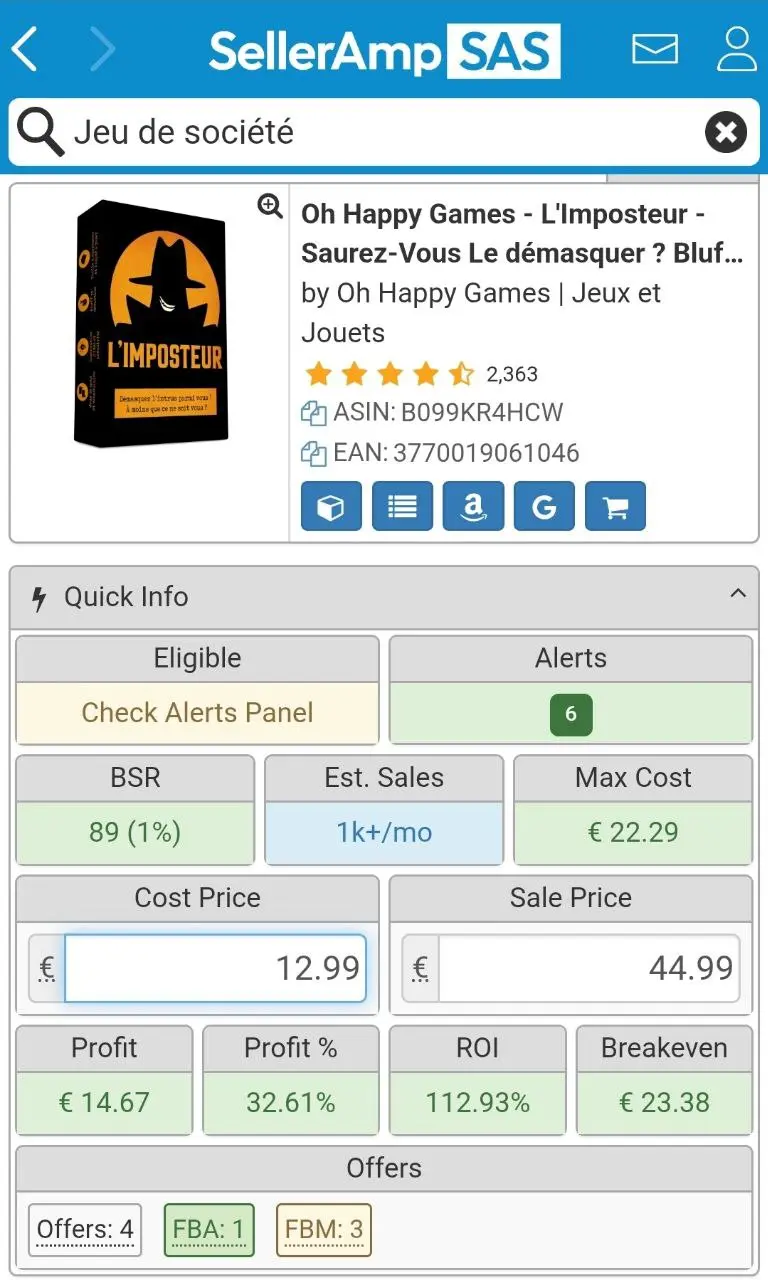
    A board game bought for €12.99 on clearance can resell for €44.99, generating  a net profit after fees of more than €14 per unit, or a 2x return on our investment. 

    Thrift stores and €1 shops also offer opportunities; a rare book bought for €2 can sell for several dozen euros online.


    Online arbitrage (OA): sourcing from your couch


    Online Arbitrage means buying discounted products online regardless of your location! 

    The advantage is being able to explore many sources without traveling. The tradeoff is that you need to be rigorous about the supplier, purchasing terms, and traceability.

    Whichever method you use, SellerAMP is the essential tool that supports your sourcing and helps you identify  opportunities by comparing Amazon prices with available deals.


    Our recommendation for getting started and growing


    Start with Retail Arbitrage to learn how to identify profitable products with a low investment. This method introduces you to FBA fees, meaning Amazon handles preparation and shipping; the Best Seller Rank (BSR), which is the product’s rank in its Amazon category; and Amazon trends. Buy 3 to 10 units of 3 to 5 products to test the market without major risk.

    Once you have mastered the basics, move to Online Arbitrage to automate and scale your business. 

    SellerAmp saves time when analyzing product listings. Use it to quickly rule out poor leads, then take two extra minutes to check eligibility and the supplier before buying.

    The smartest approach: Combine both methods: use retail to test local deals and online sourcing to source worldwide. 

    You can also buy a promising item locally in small quantities, then order in bulk online if sales take off. This multiplies your opportunities while reducing dead stock.


    Amazon arbitrage, private label, dropshipping: comparing Amazon sales models


    For entrepreneurs looking to sell on Amazon, choosing a business model is a decisive decision. Each method has differences specifically suited to different seller profiles. 

    The table below compares the key characteristics of Amazon arbitrage (RA/OA), private label, and dropshipping, allowing readers to quickly understand the differences in costs, profitability, and management.


    Comparison of Amazon sales models

    Criteria Amazon arbitrage (RA/OA) Private Label (Own Brand) Dropshipping
    Startup cost Low (€500–€2,000) High (€5,000–€10,000+) Very low (€0–€500)
    Time to launch Fast (a few days) Long (several months) Fast (a few days)
    Profit margins Good to excellent (30%–60%) Very high (40%–60%) Low (10%–30%)
    Risk level Low High High (ad management)
    Scalability Medium to high Very high Limited


    This comparison highlights why Amazon arbitrage is a sound choice for new sellers. With a minimum investment of €500 to €2,000, this model offers a quick return on investment and limited risk because products can be tested in small quantities. Unlike private label, which requires substantial upfront investment and a lengthy product-creation process, arbitrage lets you start in just a few days.

    Even though dropshipping has an even lower startup cost, its low profit margin (10% to 30%) and dependence on suppliers and especially advertising make it less attractive in the long term. Amazon arbitrage, by contrast, combines the best of both worlds: an accessible entry point and significant margins (30% to 60%), while offering growth potential through possible automation via prep centers.


    A step-by-step guide to getting started with Amazon arbitrage


    Preparation: legal status and seller account

    person holding pencil near laptop computer


    To get started: 

    1. choose sole proprietor status. This simple, cost-effective status lets you get started quickly. 
    2. Create a Professional seller account in Amazon Seller Central (€39/month excl. VAT) to access essential tools. 
    3. Choose FBA (Fulfillment by Amazon) to outsource logistics, a solution used by 85% of full-time sellers.


    Sourcing: finding profitable products

    magnifying glass on white table


    For Retail Arbitrage, explore retailers such as Carrefour or Leclerc, as well as discount chains such as Action, NOZ, or Stokomani, which regularly offer end-of-line promotions of up to 80% or 90%. Pharmacies and para-pharmacies, as well as stores such as Centrakor, are often full of bargains, particularly in cosmetics, personal care, and baby products.


    For Online Arbitrage, use tools such as Actorio, which analyzes hundreds of French and European merchant sites, including Amazon.fr, Cdiscount, Fnac, and Auchan.fr. 

    For example: a toy listed at a €50 retail price may be reduced to €7 at NOZ or Action, then resold for €40 to €50 on Amazon, generating an attractive net margin.


    Analysis: making decisions with the numbers


    Analysis makes the difference. Here is a real case shown in the SellerAmp screenshot: the board game L’Imposteur has a purchase cost of €12.99, an analyzed sale price of €44.99, a displayed profit of €14.67, and an ROI of 112.93%. The screenshot also shows 4 offers, including 1 FBA and 3 FBM. This is exactly the kind of reading that turns a promotion into a sound purchasing decision.

    --> Aim for at least a 50% ROI on standard products. 


    Purchasing and preparation


    • Apply the "3–10 rule": buy 3 to 10 units of different products to test the market. 
    • FNSKU labels are automatically generated by your Amazon Seller Central when needed. 
    • Pack your products carefully; 83% of unshippable items are caused by insufficient packaging. 


    Shipping to Amazon FBA


    • Use Amazon partner carriers (such as UPS) to save up to 70% on costs. 
    • Consolidate your shipments: costs are lower when you send as many units as possible in one package, and it helps prevent your goods from arriving damaged at Amazon warehouses.
    • Check your FNSKU labels to avoid labeling errors that affect 15% of new sellers.


    Management and optimization


    • Channelmax, a repricing app, adjusts your prices in real time to win the Buy Box (which accounts for 80% of sales). It is not essential right away, but it makes management and profit easier once your inventory has grown significantly.
    • SellerAMP monitors IP risks and competitor strategies. 

    All this therefore allows you to reinvest 100% of profits during the first 3 months to accelerate your growth. Sellers who do so see their income more than double in 6 months.


    The essential tools for maximizing your profits​


    The winning trio for analysis and sourcing SellerAMP logo


    SellerAMP SAS is an essential tool for Amazon arbitrage. Its Chrome extension displays ROI, restriction alerts (risky brands), BSR, and the number of FBA/FBM sellers in real time. 

    The Keepa chart is included and transforms historical analysis with 180-day charts. It reveals Buy Box fluctuations and competitor inventory.


    Sellerboard: your business dashboard


    Sellerboard logo


    Sellerboard centralizes ALL Amazon costs (from seasonal storage fees to unsellable returns) 

    Its KPI dashboards track sales, advertising, and net profit, with exchange-rate integration. 

    According to a Sellerboard test, its users earn an average 25% additional margin thanks to its accurate profit calculator.


    Other tools to automate and optimize


    • Tactical Arbitrage: This software scans 1,400+ supplier websites.
    • Channelmax : At $20 /month, it adjusts prices based on inventory and BSR. According to its users, this repricer increases Buy Box share by 40%.
    • Coupert and Igraal: These extensions earn 5–10% cashback and also offer gift cards at 20% off, useful for recurring expenses.


    In 2025, Amazon arbitrage requires strategic tools. SellerAMP, Keepa, and Sellerboard form a strong foundation, but their effectiveness is amplified by Tactical Arbitrage for sourcing, BQool and Channelmax for repricing, and cashback extensions. According to a Sellerboard survey, sellers using these tools earn 3 times more than those who do not.


    Concrete examples and earnings estimates: how much can you really make?


    Data-backed case studies


    Real case analyzed in SellerAmp and Keepa: the LEGO Technic F1 Oracle Red Bull Racing RB20 has a purchase cost of €50.00, an analyzed sale price of €169.00, a displayed profit of €60.13, and an ROI of 120.26%. The screenshot shows the SellerAmp calculation, available offers, and Keepa history. It is concrete proof of the method: find, analyze, then decide with the numbers in front of you.

    Concrete Amazon arbitrage example: a LEGO toy bought for €50 at Carrefour and resold for €169 on Amazon, generating €60 in net profit after FBA fees with a 120% ROI. SellerAMP and Keepa screenshot showing price, offers, and sales history.


    Set realistic income goals


    Earnings depend on your budget, time, and strategy. 

    With €500, a reasonable goal is to test your method, understand your mistakes, and find repeatable criteria. Some people progress quickly, others more slowly: what matters is keeping precise records of every purchase and reinvesting only in what you understand.

    For example: ​by reinvesting 100% of profits during the first 3 months, a seller can grow inventory from €500 to €2,000. 

    Set your own margin threshold based on your budget, time, logistics, and the level of risk you accept. What matters is accounting for every cost: purchase price, commissions, FBA or shipping, preparation, transport, storage, returns, and VAT where applicable.


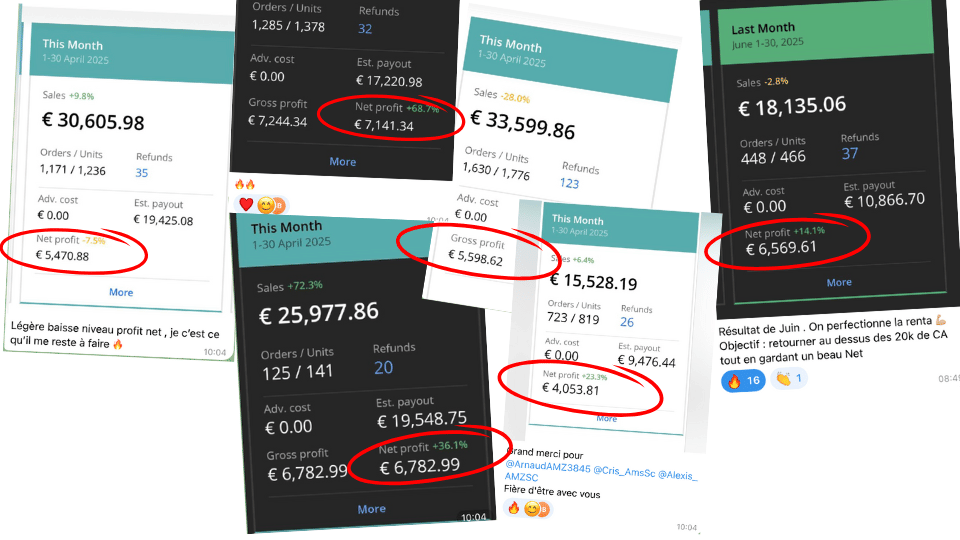
    Real Amazon arbitrage results tracked with Sellerboard: monthly sales exceeding €30,000, net profits between €6,000 and €7,000, evidence of profitability with ROI above 40%.


    5 beginner mistakes that can sink your business (and how to avoid them)


    • Ignoring Keepa charts: a risky purchase

      Buying without checking Keepa history exposes you to the risk of purchasing a product in free fall. 

    Example: a €30 toy in December can drop to €15 in January. Solution: analyze 3 months, then 1 year of Keepa data to anticipate seasonal trends. 

    A stable price history can be a good signal. You still need to check demand and restrictions: a nice curve alone does not make a product a good decision.

    • Ignoring brand restrictions: a logistics disaster

      53% of FBA rejections come from prohibited products. 

    Use SellerAMP and your Seller Central to check your eligibility before purchasing. 88% of intellectual-property-related suspensions result from a lack of initial verification. 

    Concrete case: a seller avoids €1,500 in losses by declining a batch of Google Chromecasts thanks to these checks.


    • Calculating profitability: the lack of financial visibility

      42% of beginners underestimate hidden costs such as storage and packaging. 

    Sellerboard includes 32 cost parameters for precise analysis. 


    • Starting a price war: a self-destructive strategy

      Dropping your price by 10% for the Buy Box triggers a 15% drop for everyone. 

    Use a repricer such as Channelmax to adjust prices without eating into your margins. 

    Automated systems protect margins 3x more effectively. 

    Advanced tip: set minimum thresholds so you do not fall below profitability.


    • Not reinvesting your capital: killing your potential

      Withdrawing profits limits growth to 10–15% per month. 

    Reinvesting part of your profits can help gradually expand your catalog. Decide the amount based on your cash flow, inventory turnover, and what you have actually learned from your first products.


    Training to scale: the key to moving from side income to a real business​


    Amazon arbitrage is accessible, but success depends on your ability to anticipate market changes. 

    In 2025, Amazon is changing its Buy Box algorithms and strengthening its controls, making training essential for sellers. Self-taught sellers struggle to keep up with these updates, widening the gap with trained sellers.

    Learning to understand Amazon, manage legal risks, and optimize margins helps avoid costly mistakes. 

    For example, an untrained seller could buy a product under IP monitoring, leading to an Amazon account suspension and weeks of lost income.


    Why training is an investment, not an expense

    • Arbitrage tools have become the secret weapons of successful sellers. 
    • A trained seller avoids bad purchases. 
    • A product with a 50% ROI can become unprofitable with storage fees or IP risk. 

    These details are often discovered too late by people without training.


    Strategies for growing your business

    Moving to Online Arbitrage greatly expands the number of sources you can analyze. What makes the difference is not the number of sites you open; it is your ability to quickly filter out false bargains.

    Using a Prep Center quickly becomes essential. These services prevent FBA rejections (6% of parcels are rejected without proper preparation) and free up 10 to 15 hours a month for sourcing.

    Finally, understanding Amazon’s payment cycle enables strategic reinvestment. 

    Reinvesting 100% of profits during the first 3 months can increase revenue tenfold in one year.


    Ready to get started? Your action plan for starting Amazon arbitrage today


    Amazon arbitrage is a unique opportunity to generate sustainable income in 2025. This accessible model lets you start with a modest budget while benefiting from Amazon’s logistics network.

    By combining a proven methodology, professional tools, and a disciplined approach, you can turn this strategy into a profitable business. 

    Tools such as SellerAMP and Sellerboard become your strategic allies.

    The secret lies in taking immediate action rather than waiting. Arbitrage opportunities exist every day in physical stores and online, but they never remain available indefinitely.

    Here is your concrete action plan for making your first sale happen: 

    1. JOIN FOR FREE our Telegram community, a place of support and mutual help for everyone who has taken the step of becoming an Amazon seller.
    2. Register as a sole proprietor and create your Amazon seller account
    3. Start your SellerAMP trial and learn to read Keepa charts
    4. Set aside an initial sourcing budget; even €300 is enough to get started
    5. Visit your first clearance store and analyze 50 products
    6. Buy your first profitable product and send it through Amazon FBA

    This path is within reach for anyone willing to take the first step. Modern tools remove the complexity from sourcing and make arbitrage accessible to everyone, including beginners.

    The ideal time to act is now. The first 12 months of business are decisive for building your credibility as an Amazon seller and testing your ability to identify profitable products.

    Your entrepreneurial journey begins with this first action. The tools and steps are within reach: only your decision is missing.

    Amazon arbitrage remains profitable in 2026 with low investment and controlled risk. Identify opportunities. Buy, sell. Reinvest your profits and optimize your sourcing. Ready? Create your Amazon seller account and send your first FBA shipment today!


    FAQ

    Amazon arbitrage: frequently asked questions (clear answers)

    ❓ Is Amazon arbitrage legal in France and Europe ?

    Yes. Arbitrage (legally buying a product to resell it) is allowed as long as you comply with consumer law, intellectual property, and Amazon policies. Key points: sell authentic, compliant, and safe products; respect brands (some require authorization); issue invoices and report your income.

    💶 Is it profitable in 2026 ? What results should you aim for when starting ?

    The model remains profitable if you select products with ROI ≥ 30–50% and sufficient sales volume. A cautious start (€500–€2,000 in inventory) can generate side income after 60–90 days. By reinvesting profits, many sellers reach several thousand euros in monthly profit within 6–12 months.

    🧭 What is the difference between Retail Arbitrage and Online Arbitrage ?

    Retail Arbitrage (RA): sourcing in physical stores (Carrefour, Leclerc, Action, NOZ…), ideal for getting started and learning to recognize the right signals. Online Arbitrage (OA): online sourcing (Cdiscount, Fnac, Darty, Auchan.fr…), more scalable thanks to analysis tools and automation.

    🛠️ What tools are essential for success ?
    • SellerAMP: instant ROI/profit calculations, restriction alerts, and competitor analysis. 15-day free trial.
    • Keepa: price, sales, and Buy Box history to avoid risky purchases.
    • Sellerboard: tracks actual profits and fees (FBA, returns, ads).
    🚀 Try SellerAMP (15 days free)
    🧾 What budget do I need to get started, and how can I limit risk ?

    Many start with €500 to €2,000. Buy small quantities (the 3–10-unit rule), set a minimum ROI of 30–50%, check the Keepa history and Buy Box, and avoid categories you do not understand (or that are restricted).

    🧰 How do I find profitable products in France ?

    For RA: promotions and clearance items at Carrefour, Leclerc, Action, NOZ, Stokomani… For OA: flash sales on Cdiscount, Fnac, Darty, Auchan.fr. Use SellerAMP to validate margin and restrictions, and Keepa to confirm demand.

    🔐 What should I do about brand restrictions (gating) ?

    Check the category and brand in SellerAMP before buying. If there is a restriction, target open categories (home, hobbies, toys outside sensitive brands) and/or obtain authorization by providing an invoice or authorized distributor documentation where relevant.

    📦 What are the steps for shipping to FBA ?

    Labeling (FN-SKU), preparation, condition/new checks, creating the shipment in Seller Central, sending to Amazon warehouses, tracking receipt, and listing for sale. Prep centers can handle these steps if you want to outsource.

    📑 How do I report income and VAT ?

    Choose a business structure (sole proprietorship, company…) and set up your VAT framework (scheme/OSS for intra-EU sales). Work with an e-commerce accountant; the goal is to be compliant from the start and avoid penalties.

    ⏱️ How soon can I make my first sales ?
    The time to your first sales varies by product, price, competition, FBA receiving time, and demand. To improve your odds, choose products with readable history, calculated margin, and verified sellability before ordering.

    Designed to push you to succeed!

    AMZ Seller Consulting is my experience in Amazon arbitrage since 2018, dedicated to entrepreneurs who want to save time, avoid mistakes, and build a profitable and sustainable business.

    Legal notice · Terms & Conditions · Cookies

    • infos@amazonsellerconsulting.eu
    Suivez-nous
    Copyright © AMZ Seller Consulting OÜ 2026
    English (UK) | Français | Deutsch | Italiano | Español
    Numéros 1 en arbitrage
    AMZSC.FR is not part of Amazon and is not affiliated with Amazon.