
The market will not wait: €911 billion in online sales in Europe
Amazon is often discussed as an opportunity. But before even talking about a marketplace, you need to look at what is happening around it.
Customers have not stopped buying online. They have become accustomed to comparing, ordering, receiving quickly and ordering again.
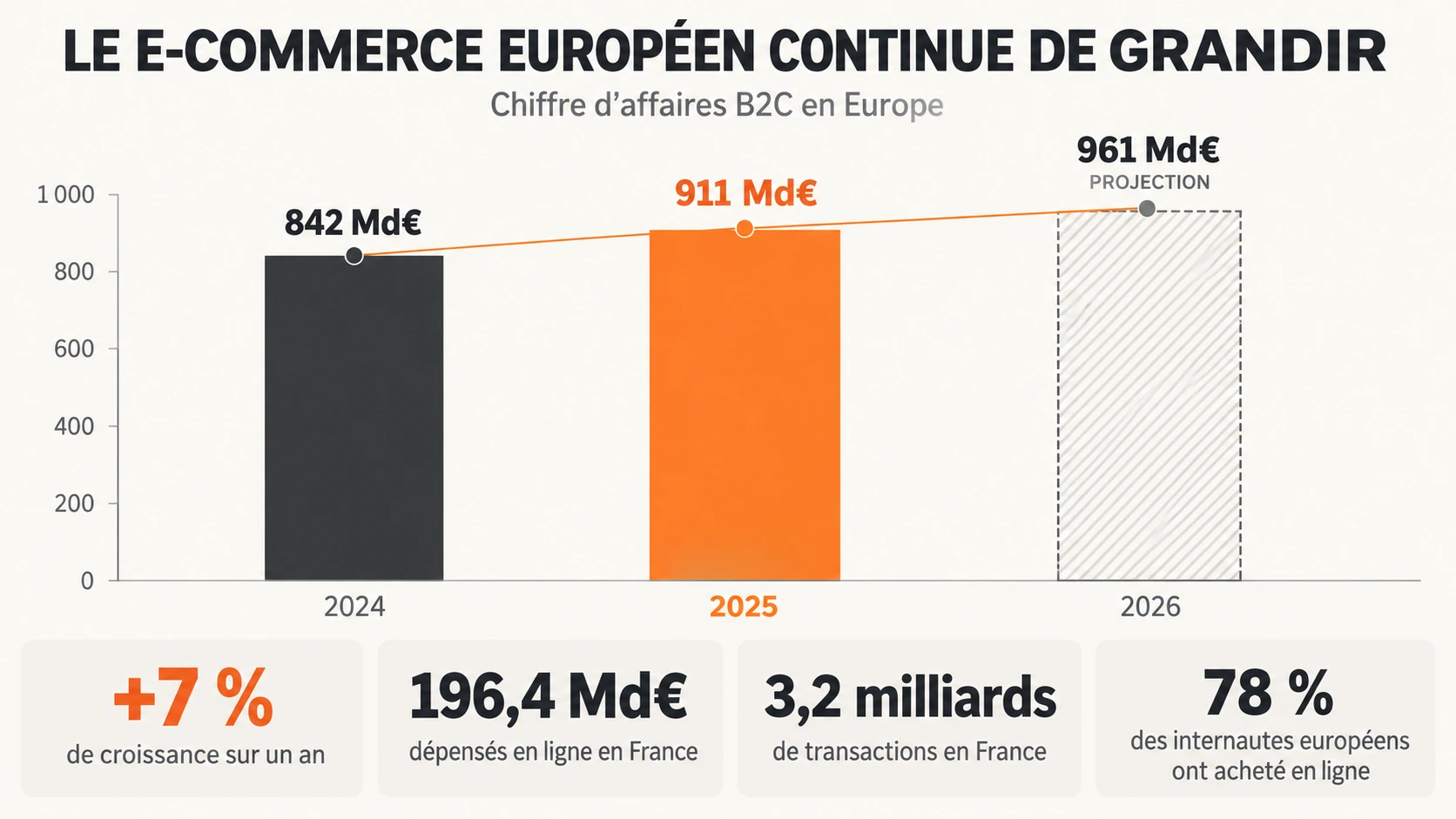
The latest European e-commerce report reveals a scale that is hard to ignore: €911 billion in B2C online sales was generated in Europe in 2025.
This figure does not describe a distant trend or a promise for later. It describes a market that already exists, with consumers already buying every day.
Key takeaway:
- €911bn: European B2C e-commerce revenue in 2025;
- +7% year-on-year growth;
- €196.4bn spent online in France in 2025;
- 3.2 billion online transactions made by French consumers over the year;
- 78% of European internet users aged 16 to 74 bought online in 2025.
In our previous article, we looked at Amazon from the inside: a marketplace in which third-party sellers play a major role. Here, the perspective is different.
The real question is: how large is the demand that a seller can tap into?
1. €911 billion: this is no longer a niche market
European B2C e-commerce rose from €842 billion in 2024 to €911 billion in 2025, an increase of 7%.
Western Europe alone accounts for €523.1 billion of that total. It is the continent’s largest e-commerce region.
The report forecasts €961 billion for 2026. That is a projection, not a guarantee. But the current picture is already clear enough: online commerce continues to carry significant weight in European shopping habits.
This is not a wave that may arrive one day. It is a motorway already carrying millions of orders.
2. In France, online shopping is increasing
In 2025, French consumers spent €196.4 billion online across all sectors. This was up 7% year on year.
Perhaps the most telling figure is not even the revenue. It is the 3.2 billion transactions completed online in a single year, up 10%.
In other words, online shopping is not limited to a particular time of year or type of customer. It has become a consumer habit.
For Amazon arbitrage, it is of course important to be precise: the €196.4 billion total includes products and services. Product sales reached €76.1 billion, up 4%.
This distinction matters. It avoids inflated figures. And it makes the finding even more compelling: demand is continuing to grow, even for products.
3. Customers are already online. There is no need to create their demand.
According to Eurostat, 78% of European internet users aged 16 to 74 bought or ordered online in 2025. In 2015, the figure was 62%.
Over ten years, consumer behaviour has changed in scale.
When you do arbitrage, you do not start from scratch with a product idea that needs promoting. You look at products customers are already searching for, retailers are already selling and marketplaces already make accessible.
Your job is not to create demand. It is to check whether a specific product can be bought at the right price and then resold with a sound margin after fees.
4. The train is already moving. The skills, however, need to be built now.
The wrong conclusion would be to read these figures and believe that every product is profitable, or that everyone should get started without a method.
A huge market does not remove competition. It makes product selection even more important.
You need to know how to compare a purchase price with a selling price. Check the fees. Understand the competition on a listing. Avoid restricted products. And do not turn a simple promotion into dead stock.
But waiting indefinitely for the ‘next business opportunity’ does not make the current market disappear. While people look for the perfect new opportunity, customers keep ordering and price gaps continue to exist.
Amazon builds the motorway: audience, payments, trust, logistics and delivery. Arbitrage means learning to use it through data-driven decisions, rather than building the entire infrastructure yourself.
In conclusion
€911 billion in Europe. €196.4 billion in France. 3.2 billion transactions in one year.
These figures do not tell you which product to buy tomorrow. They tell you something simpler: online demand is already vast, tangible and lasting.
So the question is not: ‘Do people still shop online?’
The question is: do you know how to analyse a product before committing your money?
Real-world feedback, product analysis and opportunities to explore with other sellers.
Sources
- European E-commerce Report 2026 — executive summary (2025 data, published on 22 September 2026).
- FEVAD — Review of e-commerce in France in 2025.
- Eurostat — E-commerce statistics for individuals (data extracted in February 2026).